

The “Hidden Switch” That Controls Your Energy: Circadian Rhythms
Imagine trying to bake a cake, but you turn the oven on after you’ve put the frosting on. It doesn’t work because the timing is wrong. Your body works the same way. This is your Circadian Rhythm—an internal 24-hour clock that dictates when you burn fat, when you store sugar, and when you repair cells.
When this clock is synced, you feel effortless energy. When it’s broken, you feel like you’re constantly swimming upstream against your own biology.
The Master Clock: The SCN
Deep within your brain’s hypothalamus lies a tiny cluster of about 20,000 neurons called the Suprachiasmatic Nucleus (SCN). This is your body’s “Master Clock,” and it acts as the conductor of a vast biological orchestra. While every organ in your body actually has its own peripheral clock, the SCN keeps them all in harmony.
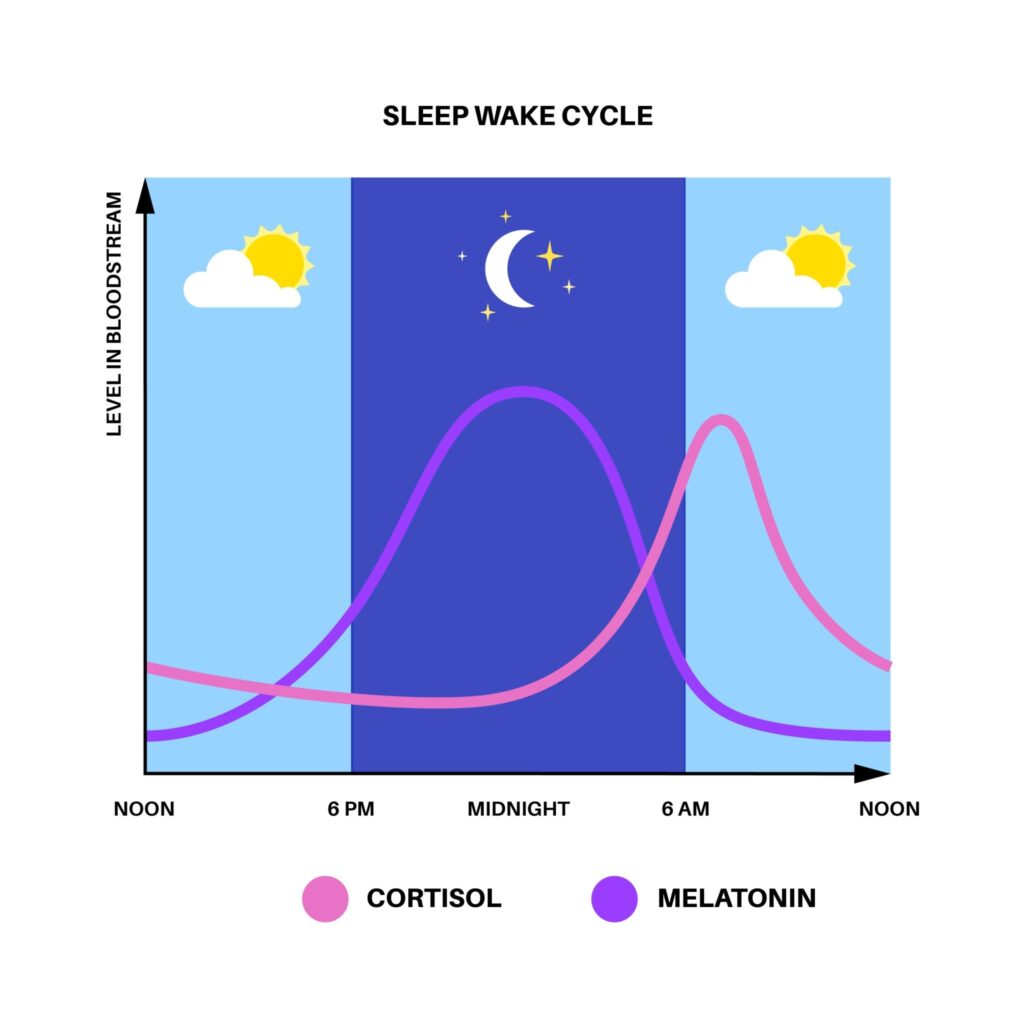
The SCN reacts to one thing above all else: Light. When high-intensity blue light (specifically from the sun) hits the melanopsin receptors in your eyes in the morning, it triggers a spike in Cortisol—your “get up and go” hormone. As daylight fades, the SCN signals the pineal gland to begin the production of Melatonin, the “hormone of darkness,” which lowers your core body temperature and prepares your systems for rest.
The Modern Crisis: “Social Jetlag”
The problem? Modern life is a “rhythm disruptor.” We bathe in high-energy blue light from smartphones at 11 PM and sit in dimly lit, windowless offices at 10 AM. This creates a phenomenon known as Social Jetlag—the discrepancy between our internal biological clock and our external social schedule.
Your body becomes fundamentally confused. It tries to digest a heavy dinner at midnight when it should be producing Growth Hormones for cellular repair and memory consolidation. When these signals cross, your biological machinery begins to grind—leading to persistent brain fog, chronic fatigue, and a weakened immune system that can’t distinguish between “work time” and “rest time.”
Why It Matters for Your Metabolism
Your metabolism isn’t a static engine that burns fuel the same way 24/7; it is a highly choreographed, time-dependent process. This field, known as Chrononutrition, suggests that when you eat is as important as what you eat.
- The Hunger Tug-of-War: Research shows that disrupted rhythms lead to significantly higher levels of Ghrelin (the hormone that makes you hungry) and lower levels of Leptin (the hormone that tells you you’re full). Essentially, being out of sync tricks your brain into thinking you are starving, leading to late-night sugar cravings that are physiologically almost impossible to resist.
- The Insulin Gap: Your body’s Insulin Sensitivity—its ability to move sugar out of the blood and into cells—peaks in the morning and drops significantly as the sun goes down. A high-carb meal eaten at 10 PM causes a much sharper, more damaging glucose spike than the exact same meal eaten at 10 AM. By ignoring the clock, you are forcing your body to store fat instead of burning it.
The 3-Step Reset
You don’t need a total lifestyle overhaul to flip the switch back to “on.”
- Prioritize Morning “Photo-Biology”: Aim for 10–20 minutes of natural light within an hour of waking. Even on a cloudy day, the lux (light intensity) from the sky is significantly more powerful than the brightest office LED. This “sets the clock” by suppressing lingering melatonin and anchoring your rhythm for the next 16 hours.
- The “Digital Sunset”: Dim your overhead lights and utilize blue-light filters two hours before bed. This decrease in light intensity signals to your metabolism that the “working day” is over and the Repair Phase—where your body fixes damaged DNA and clears metabolic waste from the brain—has officially begun.
- Narrow the Feeding Window: Try to keep your meals within a 10-12 hour window (e.g., 8 AM to 6 PM). Giving your digestive system a consistent “down period” allows your peripheral clocks in the liver and gut to sync up with the Master Clock in your brain.
Sources & References:
- NIGMS: Circadian Rhythms Fact Sheet
- Satchin Panda, Salk Institute: The Effects of Time-Restricted Feeding
- Nature: Circadian disruption and metabolic disease